
You know how, in sci-fi movies, people walk into their homes and everything just reacts? Lights dim, the temperature adjusts, the blinds come down, and a playlist starts up like magic. Years have passed when such luxury would have seemed reserved only for rich people. Thanks to smart homes, the frenzy created by such smart technologies as those smart thermostats is now putting them on the brink where fiction is getting real life slowly.
And honestly? It's not just the device's "cool factor" anymore. It's about comfort, efficiency, and wasting much less on those dreaded utility bills. Let's look into how these programmable thermostat devices not only do your heating up and cooling down but also integrate other devices into your home network-somewhat like the conductor of a digital orchestra.
Before we get to the juicy part about integration, let’s clear the air: how do smart thermostats work anyway?
In simple terms, they’re like the clever cousin of your old-school dial thermostat. You spend lots of time adjusting temperatures, while these modern smart ones learn your pattern of movement-they know when you are in, when you leave, or when you will be returning home. They will adjust the temperature as required without your having to lift a finger. The best ones connect through Wi-fi, allowing you to alter the settings-from your phone-even while sitting on a beach hundreds of miles away sipping margarita.
Most of the smart thermostats probably account for humidity, forecasts, and energy usage trends. They’re not just temperature setters; they’re tiny, wall-mounted brains that keep your house in balance.
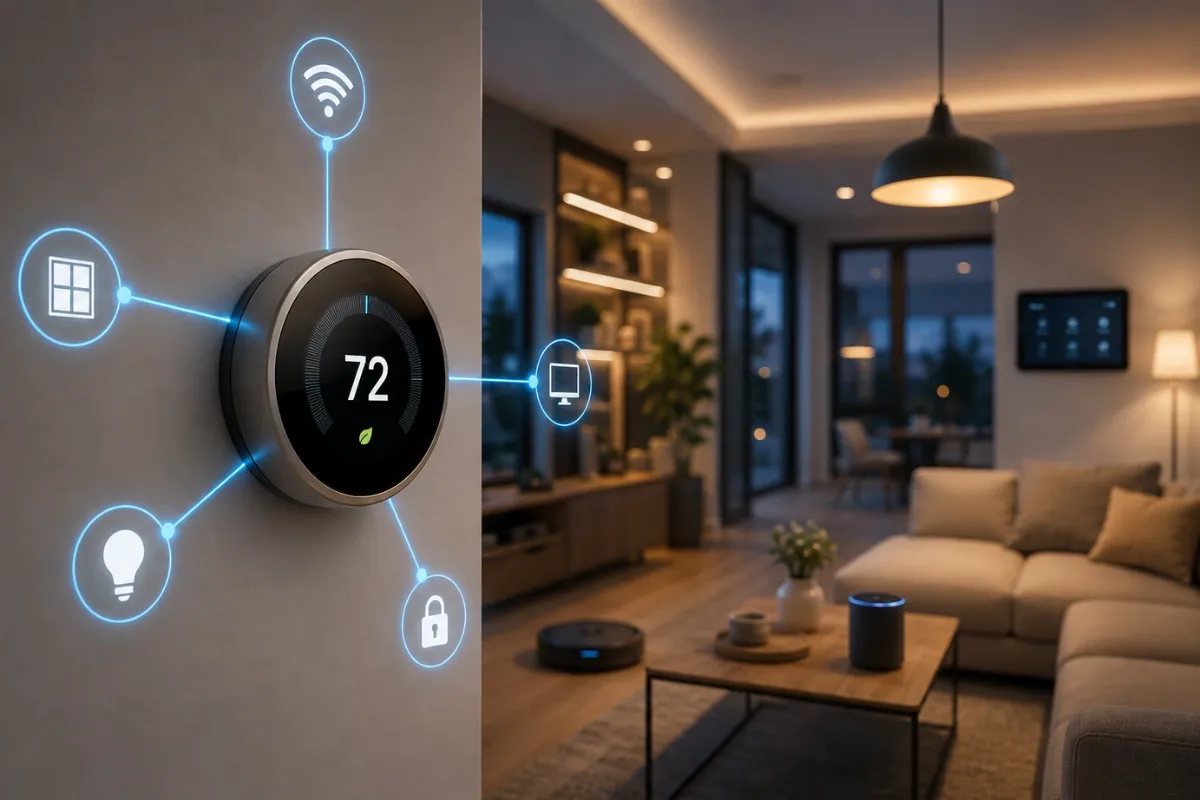
This is where the real magic happens. A normal thermostat is basically a one-trick pony: fire it up, cool it down, and loop. However, smart thermostats for home are designed to communicate with your voice assistants, lighting system, security devices-and sometimes your utility company. That is where the fun begins.
A description of the smart thermostat as some sort of Superintendent, bossing the entire smart home infrastructure, would do justice. It is not just controlling the HVAC system; it manages everything toward achieving the feel of a truly integrated living space.
Imagine this scenario:
That is synergy, not simply comfort.
The most important, but often neglected, advantage of smart thermostats is that it saves money without making you feel as if you were living in a cold, dark cave. An energy-saving thermostat learns about when you need climate control and when you don’t, thereby reducing heating and cooling costs.
Instead of running the AC at full swing while you’re out for eight hours, it knows when to throttle back. Some even produce a monthly report so you can see just how much energy you’re saving and possibly show off to friends about it.
Some more points for consideration here are that with the integration of smart plugs, smart lights, and smart appliances, the house will not only be smart but also be an economic thinker-smart. Who would not like to save some bucks while living comfortably?
If you’re already sweating at the thought of installation, breathe. Most times, the installation process of a smart thermostat is simpler than expected. Most of them come with detailed step-by-step instructions, and many even have an application that takes people through the process verbally (and with fewer confusing diagrams than your IKEA bookshelf).
Usually you would:
Some older HVAC systems may take some work, like using a C-wire adapter, but mostly, folks just find it easy.
And once you are set up, it's just a matter of interesting times connecting your home smart thermostat to the rest of your ecosystem.
So how do smart thermostats actually sync with other devices? Most use platforms like Apple HomeKit, Google Home, or Amazon Alexa as the connective tissue.
The whole experience is less about individual gadgets and more about an ecosystem that “gets you.”
So, which are the best smart thermostats? Well, you should almost never ask that. It depends on what you have and what you like. Nest and Ecobee and Honeywell are the main contenders, with each thermostat carrying its own weight. Nest is good-looking and easy to use; Ecobee does really well with multiple rooms; Honeywell is the budget-friendly choice with decent features.
The good news? No matter which route you take, you’re getting more than just a thermostat. You’re buying into an intelligent home system that can grow with you.
They are designed to be the gateway of a connected home, where devices constantly talk to each other and schedules are streamlined without hampering efficiency. Really, the bottom line is that smart thermostats can be gadgets that can do much more than setting your heat setting or your AC installation.
You have the device that will take you far upon investment course; whether looking for the best smart thermostats in today's markets or just wondering how to install smart thermostats; the smart truth comes with comfort, convenience, and savings as dividends. Well, you are not dreaming; it has come to realization.
If before, people thought this kind of house was just fiction, that house is now real, and it is nearer to come to reality with every possible option, such as Travis Perkins, where you could start making your home even brighter.
For more guides on practical tools, modern solutions, and worksite essentials that matter, visit Travellboom.